Shadow AI in Healthcare: The Innovation Opportunity Hospitals Can’t Ignore
By Health Cloud Solutions. Healthcare organizations are rapidly embracing artificial intelligence to improve clinical workflows, reduce administrative burdens, and enhance patient experiences. Yet a growing challenge is emerging behind the scenes: Shadow AI.
Shadow AI refers to the use of artificial intelligence tools by employees without the knowledge, approval, or governance of IT, compliance, security, or clinical leadership teams. Examples include clinicians using public AI chatbots to summarize patient information, administrative staff generating correspondence with AI tools, or researchers analyzing healthcare data using external AI platforms.
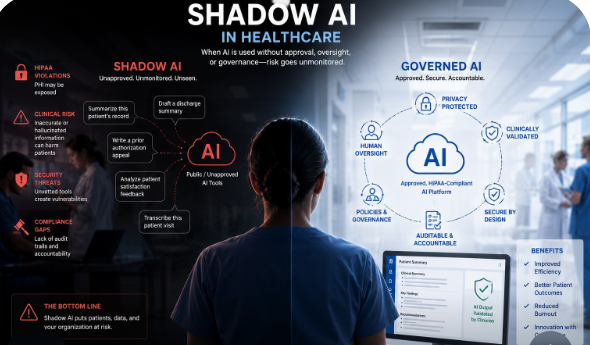
While these activities are often well-intentioned, they can create significant risks for healthcare organizations.
Why Shadow AI is Growing
Healthcare professionals face increasing pressure to improve productivity while reducing burnout. AI tools can quickly generate documentation, summarize medical literature, draft patient communications, and automate repetitive administrative tasks.
When approved solutions are unavailable or difficult to access, employees often seek their own AI tools to fill the gap. The result is widespread AI adoption occurring outside established governance frameworks.
The Risks of Shadow AI
Patient Privacy and HIPAA Exposure
The most immediate concern is the potential exposure of Protected Health Information (PHI). Employees may unknowingly upload patient data into public AI systems that are not authorized to store, process, or protect healthcare information.
Even seemingly harmless prompts can create compliance violations if patient identifiers, diagnoses, or treatment details are entered into external AI platforms. CMS guidance specifically emphasizes protecting PHI and applying strict safeguards when using generative AI technologies.
Clinical Accuracy and Patient Safety
Generative AI systems can produce inaccurate or fabricated information, often referred to as hallucinations. In a healthcare environment, incorrect recommendations, inaccurate summaries, or misleading clinical information can directly impact patient care.
Healthcare organizations must ensure that AI-generated content remains subject to human review and clinical validation. Federal guidance stresses that humans remain accountable for all AI-generated outputs and decisions.
Cybersecurity and Governance Gaps
Shadow AI creates blind spots for security teams. When organizations are unaware of which AI tools employees are using, they cannot assess risks, monitor data flows, enforce policies, or ensure accountability.
Industry research shows that unsanctioned AI applications can create significant security vulnerabilities and compliance challenges, particularly in highly regulated industries such as healthcare.
The Real Opportunity
Healthcare leaders should recognize that Shadow AI is not simply a security problem—it is often evidence of unmet business needs.
Employees are adopting AI because they see value in:
- Reducing administrative workloads
- Improving documentation efficiency
- Accelerating research
- Enhancing patient communication
- Supporting coding and billing processes
- Summarizing large volumes of clinical information
Rather than attempting to ban AI usage, progressive healthcare organizations are focusing on creating secure, governed pathways for innovation.
Moving from Shadow AI to Governed AI
Healthcare organizations should consider five key actions:
- Deploy approved, HIPAA-compliant AI platforms
- Establish AI governance and oversight committees
- Develop clear policies for AI use
- Train employees on privacy, security, and responsible AI practices
- Require human validation of all clinical and operational AI outputs
Organizations that successfully balance innovation with governance will be best positioned to capture AI’s benefits while protecting patients, providers, and sensitive healthcare data.
Conclusion
Shadow AI is rapidly becoming one of the most important governance challenges facing healthcare organizations. The question is no longer whether employees are using AI—it is whether healthcare leaders have the visibility, policies, and safeguards necessary to ensure that AI is being used responsibly. The future belongs to healthcare organizations that transform Shadow AI from an unmanaged risk into a strategic advantage through secure, compliant, and clinically validated AI adoption
Category: Uncategorized

